
It Starts at the Top
This Thing Called Culture
Before understanding how a board can best govern culture, the board needs to appreciate what exactly it is governing. Often described as “the way we do things around here”, culture is not a values statement on a poster on a wall, nor is it evidenced by a thick binder of policies; it is not even always clear from the outcome of a staff survey. Culture is the sum of behaviours that are permitted, promoted or punished within an organisation. It is also self-perpetuating. Organisations hire people for cultural fit, socialise new employees into those norms and promote those who embody them. This explains why culture can be so hard to change and when attempted at a superficial level, for example with new values workshops with a suite of supporting policies and training modules, often falls short. Real cultural change requires sustained value-based leadership in an environment where openness, respect and diversity are celebrated, backed up by incentives that reward the “how” and the “what”. It requires the board.
The Board’s Role
The role of the board in relation to culture is a subtle and balanced one. It is not to manage culture on a daily basis but nor should the board remain at arms-length. The role occupies the important middle ground of keen oversight with thoughtful engagement. In practice this involves the following key elements:
Ensure the critical infrastructure is in place
From a Code of Conduct to ethics training, conflict of interest policies, speak-up channels and due diligence procedures, directors must ensure the appropriate infrastructure and standards of probity are in place in their organisations. This is akin to laying down an ethical “base layer”. It is an important first step, but as we know from countless examples, policies and protocols are not on their own sufficient. The classic example has to be Enron, which won an award for its 64-page, word-smithed-to-perfection Code of Ethics (now a collectible item on Ebay!). If we have learned anything from these case studies in corporate malfeasance, it is that conflating culture with compliance is erroneous and that all the rules in the world are no substitute for character. Which brings us to the next step.
Appoint the right CEO and reward the Executive appropriately
On appointment, the CEO is bestowed with the organisation’s most precious asset: its reputation, and charged with the ultimate responsibility for its safekeeping. He or she will serve as a beacon of integrity and ethical conduct for all of the organisation’s stakeholders. Choosing the right CEO, and the executive team in turn, is the single most important decision the Board makes and demands commensurate investment in a robust succession planning process.
Thereafter it is essential to get the reward policy right because remuneration is a powerful cultural lever. This can be challenging in state organisations where the board typically has little input into determination of salary and benefits, but nonetheless the objecting-setting and performance appraisal should incorporate a focus on both “the what” and “the how”. When the emphasis is exclusively on the numbers, behaviours will be skewed accordingly. The consequences of this mis-alignment in terms of impact on morale, poor customer outcomes, possibly regulatory censure and reputational damage and ultimately underperformance are well-documented. VW’s “Dieselgate” highlights a culture emphasising unrealistic performance targets and an environment where “speaking up” seemed to be verboten. Intense performance pressure and a culture that rewarded unquestioning loyalty also contributed to the massive accounting fraud that led to the downfall of WireCard. Similarly at Boeing, critics have pointed to tensions between safety priorities and business pressures as contributing to the devastating 737 MAX crashes.
Boards that prioritise integrity in executive recruitment, embed cultural metrics into performance and reward processes and follow up with probing, insightful questioning send a powerful signal about what really matters. The role of the board in both CEO succession and reward therefore extends beyond governance protocols but encompasses the stewardship of organisational character across generations of leadership.
Set the values and align with strategy
If purpose is why the company exists, vision is what it wants to be and strategy articulates how it gets there, a clear set of core values must underpin the approach. Interestingly however, if you google the values of many listed companies, you’ll find a fairly consistent smorgasbord of lofty aspirations; “integrity”, “innovation”, “respect”, crop up time and again. Not that there is anything wrong with these ideals per se, but when so ubiquitous, can present like a bland list of hygiene factors. Values dictate an organisation’s cultural USP, so we encourage directors to be much more thoughtful in this area. We like the analogy of imagining you have been asked to recreate your organisation on another planet but the rocket ship only has 4 seats, each representing the best attributes of your business – what would you choose?
Act Ethically
As well as being responsible for the ethical architecture, recruiting the right leadership team and aligning values with strategy, the board must ensure that its own actions and decisions are above reproach. While it is rare for a board to deliberately endorse an illegal act, there can be a vast difference between decisions that are “legal” and those that are “right”. The wholesale governance failures at the British Post Office provide a good example of the distinction in practice. Decisions are usually right when a director is comfortable being personally accountable for their part in it, especially if it would be made known to their family or feature on the front page of the newspaper. Directors would do well to assess all decisions through that lens and determine whether they want to simply meet a bar, or raise the bar, or better, set the bar, in terms of moral courage.
Measure and Monitor culture
If “what gets measured gets done”, the Board must ensure that they have good intelligence to evidence how the organisation’s values in theory align with behaviours in reality. Too often these mechanisms for monitoring are reviewed in isolation, sanitised and rarely triangulated. At Board Excellence we have developed an innovative Culture TableTM to put some science around evaluating “the way we do things around here”.
The Board Excellence Culture Table TM
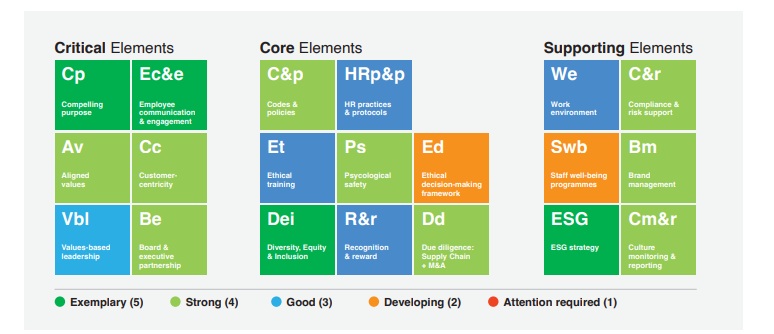
A unique, pragmatic and value-adding review of organisational culture, it helps the board and the executive team to gain clear, evidence-based insights into how the organisation’s culture is functioning – what's working really well and where targeted improvements can create the most meaningful impact.
Good directors also intuitively know that only so much governance can be done within the confines of the boardroom; they need to get out and about and experience the organisation’s culture first hand. Site visits, as long as they are not “state visits” and facilitate engagement with employees at all levels of the organisation, together with a well-constructed cultural dashboard, provides the Board with the holistic assurance it needs that the desired culture is truly living and breathing across the organisation. When Board Excellence conducts an external board evaluation, we ask each board director and executive their views on how employees and customers are treated. Their responses go to the very heart of how culture really shows up in the organisation.
It is important too that culture is a standing agenda item. Boards tend to focus on culture after a scandal, or a fine, or an exodus of talent. By that point the damage is already done. As above, cultural oversight should be embedded in the regular rhythm of the board calendar with consistent attention given to early warning signals.
Lead by example – a Special Role for the Chair
Last but not least, in order to effectively set the tone from the top, the boardroom should be a microcosm of the organisation’s desired culture, with the espoused values, including respect and openness, underpinning boardroom interactions. In this environment, the Chair is key, as this role sits at the intersection of three key relationships – with the board, the CEO and the organisation’s stakeholder base. He or she sets the culture of the board. How they run board meetings, including whether challenge is welcomed or supressed, whether all voices are heard, whether difficult questions are pursued to resolution or smoothed over in the interests of harmony, all determines whether the board functions as a high-performance team or a collection of clever individuals performing a ritual. The best chairs recognise that rich debate and inclusive culture results from embracing cognitive diversity, itself the product of different ages, gender, ethnicity and life experiences, and welcome constructive challenge and intellectual honestly over groupthink and excessive deference.
The relationship between the Chair and the CEO is the most important governance relationship and a primary channel for transmitting the board’s expectations around culture to the Executive. A Chair who engages with the CEO regularly and asks searching questions about cultural signals as well as financial performance, making it clear that leadership behaviour is as important as delivering results and that principles and profit can and should co-exist, will embed cultural accountability at the top of the house. A Chair who limits their engagement to the formal board meetings and focuses exclusively on numbers sends an equally powerful but opposite signal i.e. that culture is peripheral.
Given that the Chair’s occupies a position of unique cultural significance, it is obvious but not always the case that the Chair is a person with impeccable values. A stellar record of results delivery in their previous CEO career may be impressive, but mask a legacy of cultural carnage. Deep character due diligence is required to ensure the person who has the most influence over culture in the organisation has the integrity to exercise it appropriately and diligently. We need only look at the recent issues at the top of the house at BP plc to see how things can play out when some of these steps may have been missed in the choice of board leader.
Conclusion
There is a Dutch saying that roughly translates as “trust arrives on foot but departs on horseback”. The board is responsible for building trust in their organisations and sustaining it over the long term. By following our approach above, they will focus on doing the right things and asking the right questions, which should ultimately lead to the right outcomes. Boards that govern culture well are not doing something admirable or optional. They are doing their jobs. In summary, that job is to stand squarely behind their chosen CEO and collectively set the tone from the top while providing independent oversight on the organisation’s ethical framework and lived culture. To put it simply the board must “walk the talk” and set the example, not become one.
- Ros O’Shea is Lead Partner, Ireland & Practice Director of Board Excellence a leading international board practice, supporting boards across the Ireland, UK and over 45 countries internationally.