Optimism within the Irish SME (Small and Medium Enterprises) sector is at its highest level for over a year - according to the Linked Finance SME Confidence Index. Large SMEs, which employ between 10 and 250 employees, are the most upbeat, reporting a positivity rate of more than 72% on the index on their current outlook, while micro-SMEs (1-3 employees) were the least optimistic, with a score of just over 61%. The service sector showed the strongest positivity, at almost 66%, while there was marginally more positivity among Dublin SMEs (65%) compared to similar businesses outside the capital (62%). A degree of optimism has finally returned to micro businesses - a particularly welcome development.
Business activity
Business activity for the last quarter is trending downwards year-on-year across all SME sectors surveyed. Year-on-year trading activity is down 3% according to the index. The most recent CSO figures show that SMEs comprise 99.8% of businesses in Ireland and employ 2.3 million people here.
There is a strong divergence between mid/large SMEs businesses, which are doing very well, and smaller businesses that are still struggling. Large businesses have improved the most. Almost half of all large SMEs (48%) have seen increased business activity in the last 12 months - with only 15% reporting reduced activity - while 42% of mid-sized SMEs (4-9 people) are ahead in terms of trading over the same period. Two in five micro-businesses (1-3 people) surveyed are reporting reduced business activity year-on-year.
Budget bounce
Export businesses have been feeling the pinch over the past two years now, while indigenous only businesses are struggling a little. Q2 v Q3 shows relatively little change in these areas in 2024. While there may be a juxtaposition in SME trading activity down - with optimism up - the near flat-lining of inflation, a “Budget bounce” and a stable domestic political environment all feed positively into sentiment. Increased business costs – particularly energy - have ultimately been passed onto the consumer, with this in turn impacting spending and trading activity. However, if we are to look back to sentiment in Q3 2022 (59%), there has been a near 4% increase in positivity since across the Irish SME sector.
Business activity looking forward to Q4 2024
While micro sized businesses have a marginally negative view of short-term prospects (-3%) , they are substantially more positive looking forward into the next quarter, than they were this time last year. Mid-sized businesses expect very similar activity levels to last year, while larger businesses are particularly bullish and showing the highest level of optimism since 2021. Indigenous SMEs are showing a strong improvement from last year in terms of positive outlook to year-end. Exporters are more positive compared to last year (when there was a sharp increase in those expecting lower levels of activity) but are still just in negative territory (- 2%).
Niall O’Grady, CEO of Linked Finance said: “Businesses based in Dublin in particular are driving most of the positivity, but outside Dublin, businesses are more positive compared to last year. It is encouraging to see this uplift in optimism, particularly given the ongoing instability in the geo-political environment, and high costs that SMEs continue to face.”
Employment levels
Job creation is at neutral levels (job creation equalling job losses) compared to last year, according to the sentiment index. Mid–sized businesses are driving job creation, while micro businesses are employing considerably less people – the lowest level since the height of Covid.
Most job creation is coming from firms located outside of Dublin. Stronger job creation outside the capital has been a feature of the SME sector post Covid, with the rise in availability of employers offering hybrid working a likely contributory factor to this. Three quarters of businesses - both within Dublin, and outside of it - expect employment levels to remain the same year-on-year; 15% of SMEs outside the capital expect there to be more people employed over the period, compared to only 6% in Dublin.
The majority of job losses in SMEs continue to come from the retail and wholesale sector, with one-in-six SMEs surveyed reporting that they expect lower employment levels year-on-year. SMEs in the services sector reported a much more positive picture, with 21% likely to have more people employed by the end of 2024, compared to 2023.
“When it comes to job creation, while the overall picture is flat, what growth there is in the sector is coming from companies outside Dublin, which has been the case since Covid,” O’Grady said.
Pricing and Profits
While the movement towards higher prices post-Covid has ceased, there is little sign of businesses reducing prices to any great degree. Businesses outside of Dublin are more likely to be charging more, with 58% of SMEs surveyed in the capital charging roughly the same price for goods and services year-on-year, compared to 48% of those outside Dublin.
Micro firms remain under severe strain when it comes to profitability and have yet to return to pre-Covid levels. Large SME businesses are, however, doing much better compared to this time last year, with 42% reporting higher operational profits year-on-year. Profitability levels are under slightly more pressure in Dublin. Retail and wholesale businesses continue to be under serious profitability strain, but things are improving somewhat, with an 8% drop in those with lower profits year-on-year.
Sectoral activity
The retail and wholesale sectors are continuing to struggle, while the services sector is showing the most positivity. Some 44% of SMEs business surveyed in the retail and wholesale sector believe that their results for Q4 will be lower this year compared to last year. In contrast, almost half of those surveyed in the service sector (48%) feel their results will be higher in Q4 year-on-year.
“Quarter-on-quarter comparisons show that a stronger positive trend is evident in 2024 after a challenging second half of 2023,” O’Grady added. “Irish SMEs are adapting to the ever-changing economic and political environments, and we do believe there has been a “Budget bounce” that has contributed to this sentiment. Next year is likely to bring its own challenges, but opportunities also.”
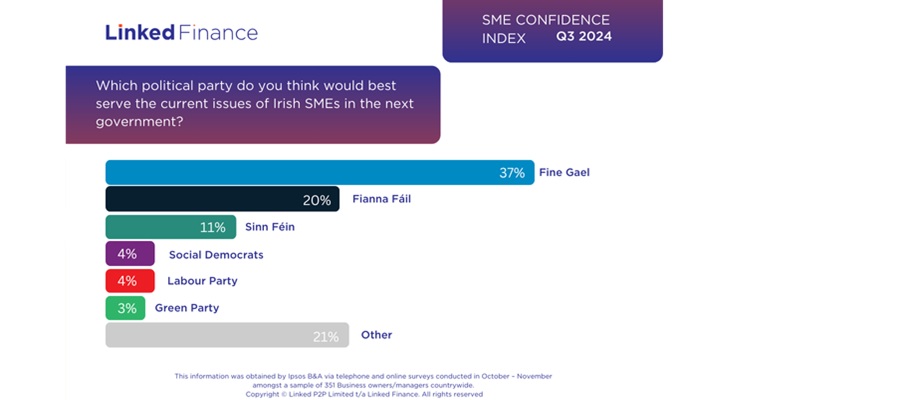
Political parties perceived to best for Irish SMEs
Fine Gael are the preferred party amongst SMEs - particularly in Dublin and have increased their lead (37%) over Fianna Fáil by points in Q2 to 17 points in Q3. The latter received 20% as the party of preference, while Sinn Féin are ranked best for business by 11% of respondents . However, 21% opted for “others” outside of the six main political parties.
With exploratory government formation talks likely to kick off soon, SME business owners will be looking to the country’s leaders to ensure they are well supported, given the potential headwinds from across the Atlantic with the election of Donald Trump and the possible impact of new tariffs on international trade and the Irish economy.